
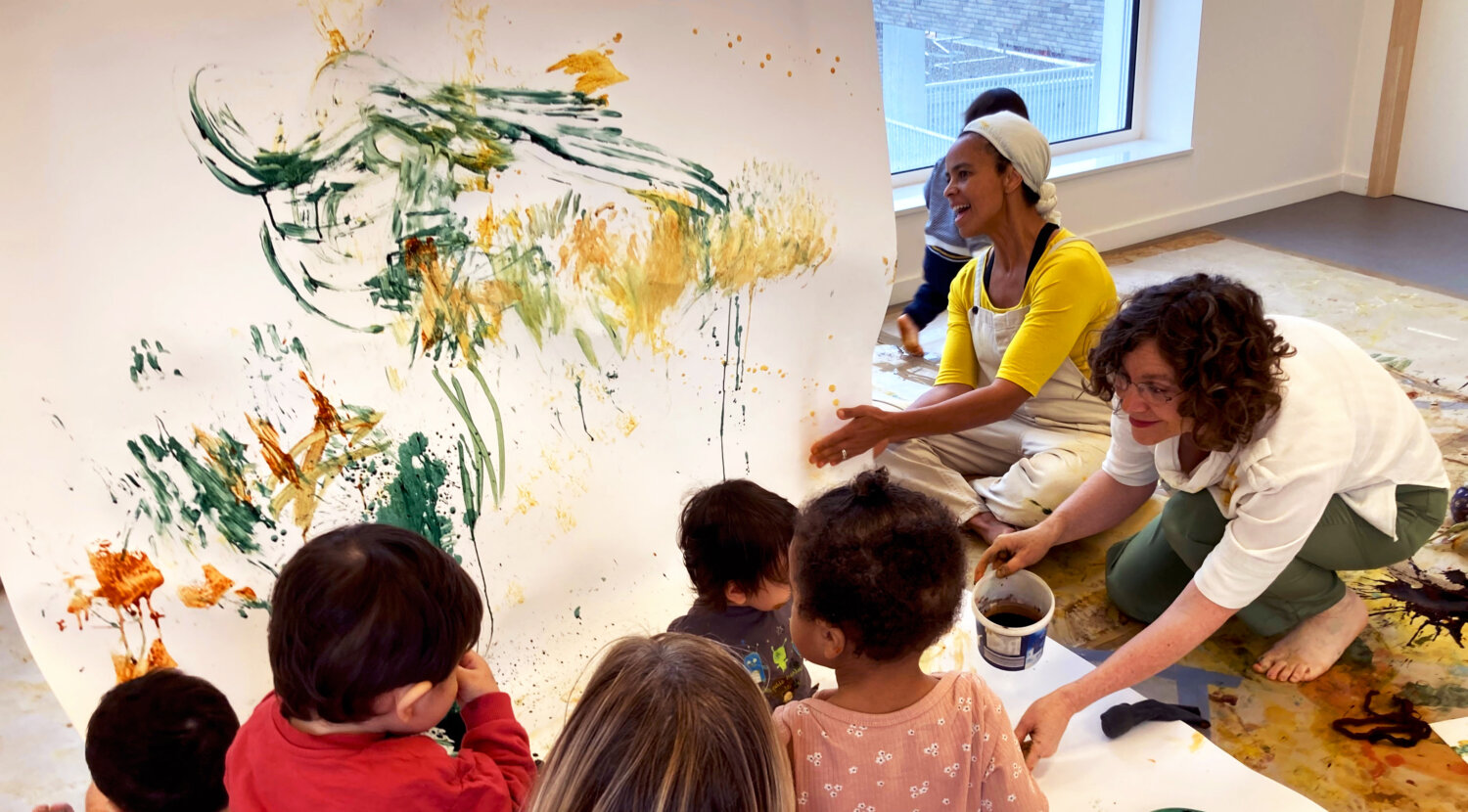

It is late November, a wintry Thursday evening. Virginie Bailly and Marie-Rose Mayele, respectively a visual artist and a musical-movement artist at Cie Squeezz, talk about their artistic journey with the very youngest children. Their passion and admiration for the uninhibitedness of children shine through.
Photography © Louis De Cordier
Beetroot, Turmeric, Sweet Pepper
From May to December 2025, Marie-Rose and Virginie developed artistic workshops tailored to the babies and toddlers of De Hummeltjes, De Speelboom and Schobbejakske. Marie-Rose: “For each daycare, we held four sessions: three at the daycare and a fourth at Community Center Everna, because we also want to bring the children and caregivers to engaging cultural places outside.”
Each session took a whole morning, including preparation and cleanup. The actual workshop with the children lasted about three quarters of an hour. Virginie: “Which matches the attention span of most children. But we also see the opposite: some just can’t get enough and are even sad when the workshop ends.”
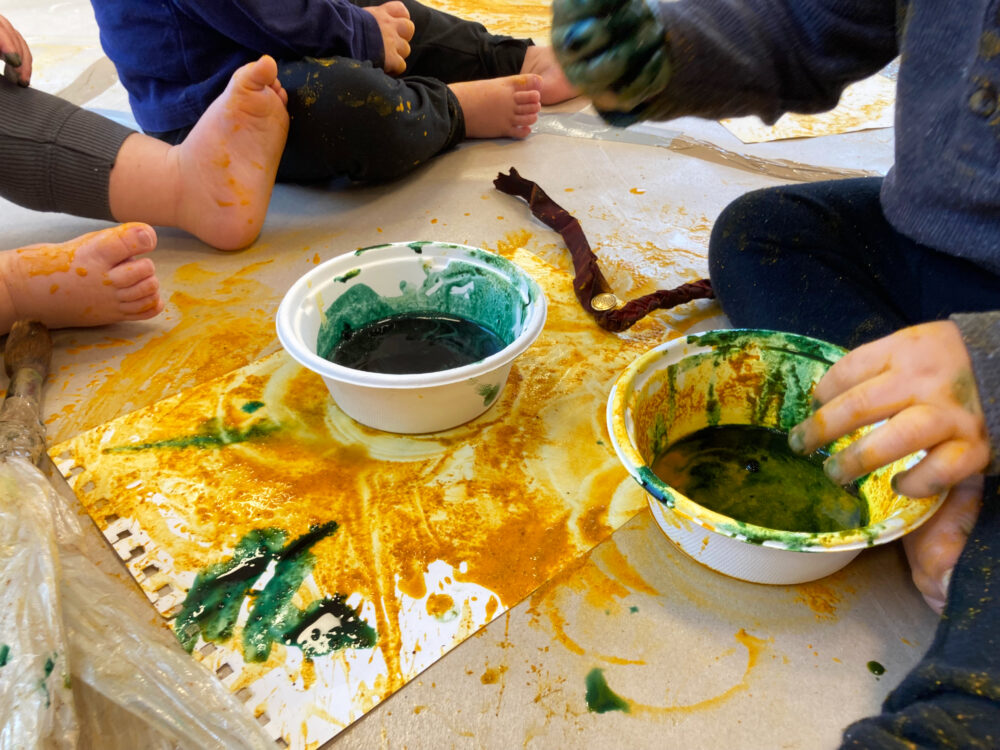
For these workshops, the artists used natural paints made from beetroot, turmeric, sweet pepper, nutshells... Virginie: “We prepared the paint fresh at the daycare, which took quite some time. In the future, we want to make it in the presence of the little ones, because it’s educational to see how spices become color.”
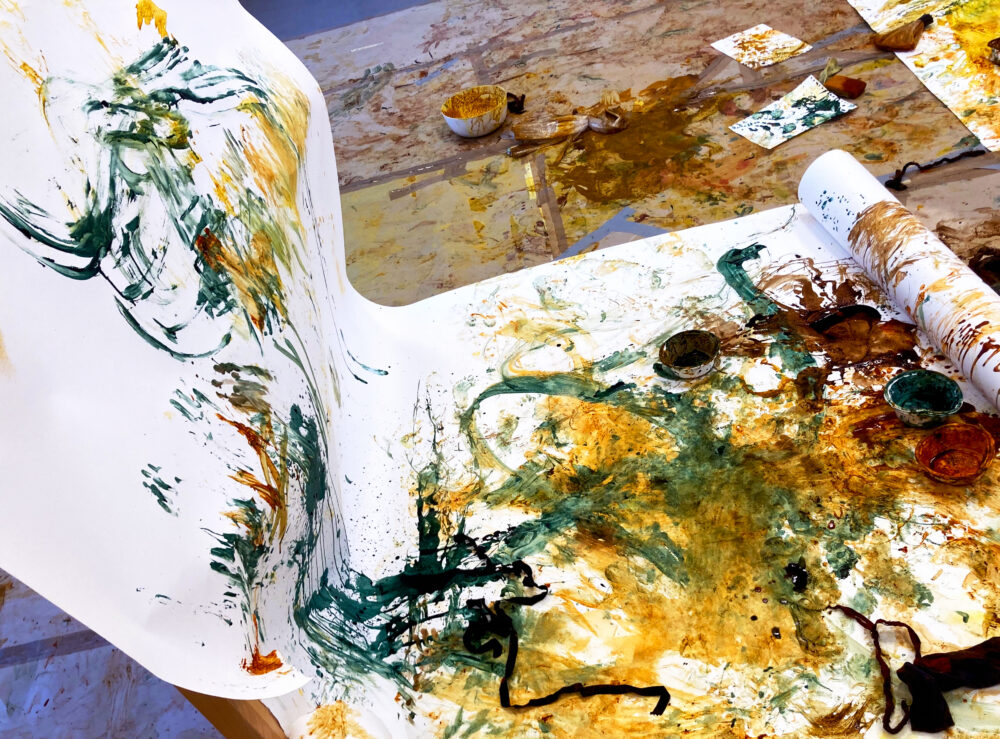
Marie-Rose: “After clearing the space and removing all unnecessary stimuli, we created our own scenography. We cut and taped large strips of tetra-brik to make our performance mat tailored to the space. We reused it during every session. This way, we created a real patchwork of paint and tape on which the children from the different daycares left their mark.”
Lights Off, Spotlights On
Once the space was ready and the paint prepared with warm water—otherwise it would be too cold for the babies’ and toddlers’ bodies—the performance could begin.
With soft plucking, fluttering, tooting, whistling, and scraping sounds, Marie-Rose created a unique soundscape each time. She used materials at hand: paper, paint tools, her voice... Occasionally a recorder or a pre-recorded audio fragment. Virginie: “During one session, we let a strip of paper roll into the painting space like a waterfall. This created an extra spatial dimension where we splattered paint in an Action Painting style. This also added an extra touch to the soundscape.”
Not everyone was equally eager to get dirty, but the impact of watching should not be underestimated. Even those standing aside were fully immersed musically and visually.
- Marie-Rose
Virginie: “To the soft tunes of Marie-Rose, I started painting. We sat in a circle, paint pots arranged around us. I took one of my homemade paintbrushes, for example, a perforated bag used for selling mangoes, dipped it in paint, and left some paint traces on the paper at will. I started small, a few brush strokes on a white sheet, and gradually introduced the different paints and shades.”
Magic
Marie-Rose: “And then you see the magic: once the kids, caregivers, and parents find their rhythm, the colors and sounds do the rest. The kids started moving; some faster than others, but that’s perfectly fine. There was lots of mopping, smearing, sweeping, squishing, and scribbling, and the caregivers hummed or sang, supported the kids, or painted along.”

“Fingers, hands, arms, feet were used; the whole body could become a paintbrush.” Virginie: “There are plenty of child-friendly paint tools for those who don’t want to get dirty: children’s socks with a scrubbing sponge sewn underneath, ribbons, pieces of old clothes I transformed into stamping brushes...”
Virginie: “To the rhythm of the music, my movements grew bigger, like a sea getting wilder; I stood up, dipped my feet in paint, painted with more force and flair, swept bold strokes on the paper. The children first made small, cautious movements on a small sheet of paper, then fully unleashed themselves with hands and feet in the whole space.” Marie-Rose: “It’s as if we took a journey together, starting gently and then bursting loose, until we ended softer or harder together.” Virginie: “At that moment, the paint was often used up, or some kids quietly were done. This always happened very intuitively.”
Everyone and everything covered in paint
Virginie: “Parents were asked to dress, together with their children, in clothes that could get dirty. Afterwards, the kids were cleaned up and got fresh clothes.” Marie-Rose: “Not every child or caregiver was always equally eager to get dirty. But that’s part of it, and the impact of watching should not be underestimated; even those standing aside were fully musically and visually immersed.”
Making art with the very youngest requires a lot of energy but also gives a lot. You are fully in the moment, very aware of what happens around you. That brings calm and inspiration and is enriching.
- Virginie
Virginie: “From experience, we know: as an artist, you have to be flexible. Not every day is the same, not every child is always equally motivated, not all caregivers are always equally enthusiastic.” Marie-Rose: “We learned that a good dynamic and a nice workshop stand and fall with the energy and intensity we put in. We see ourselves as performance artists, where children and caregivers are both audience and participants; the more we respond to each other, the easier it is for our audience to actively join in. And so the children also become performance artists, who help determine the direction; a child’s shout becomes part of the soundscape, a paint stroke partly determines the process and result.”
Inspiration for one's own artistic practice
Virginie and Marie-Rose are bursting with ideas and want to continue working with the very youngest. Marie-Rose: “We would like to do a performance with babies and toddlers, as we do now, but with an audience that only watches.” Virginie: “Or we think about how to spatially and sensorily enlarge and strengthen the painting landscape, for example by simultaneously projecting a live recording of the workshop onto the ceiling.”
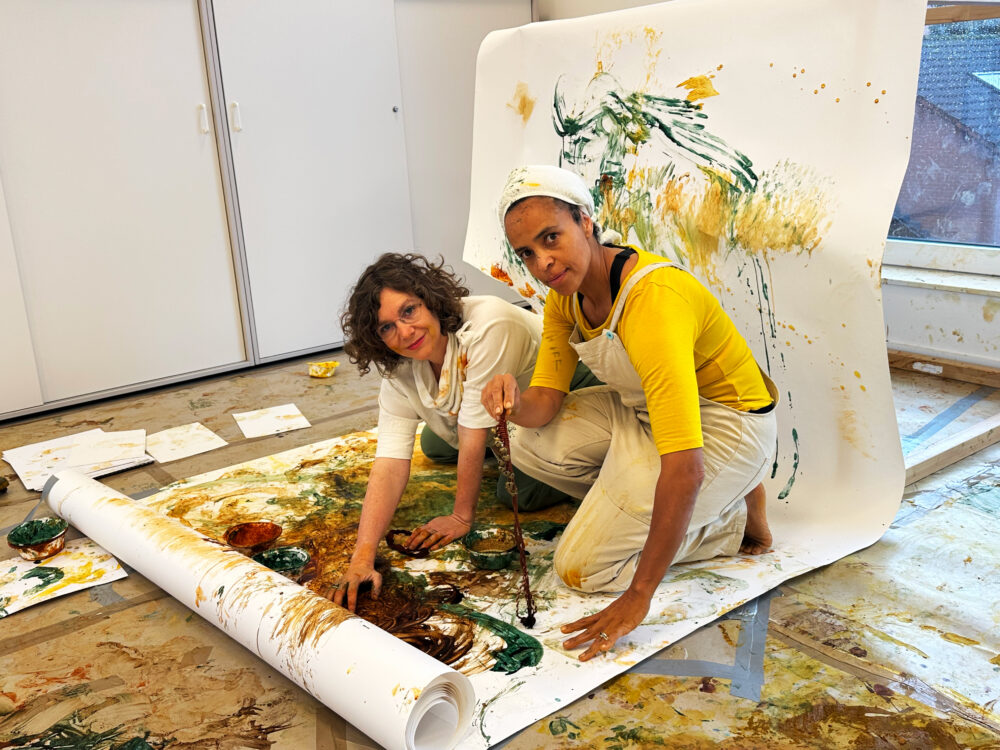
Marie-Rose: “We also dream of our own publication, with artworks by the very youngest. The contemporary visual art scene, unlike for example the performing arts, has not yet embraced art with the very youngest. Artists working with the very youngest are often not taken seriously; it is often seen as a side project. While maybe this is the real work?”
Virginie: “Making art with the very youngest requires a lot of energy but also gives a lot. Because it happens in the moment: you watch the small actions, you are very aware of everything happening around you. That brings calm and inspiration and is enriching. At the end of an artistic session, we are exhausted and at the same time bursting with energy. The uninhibitedness of the children fully expressing themselves, their intuitive reactions, their curiosity, their spontaneity… This is what really creates magic.”